Childhood Myopia Management: Why Glasses Aren’t Enough
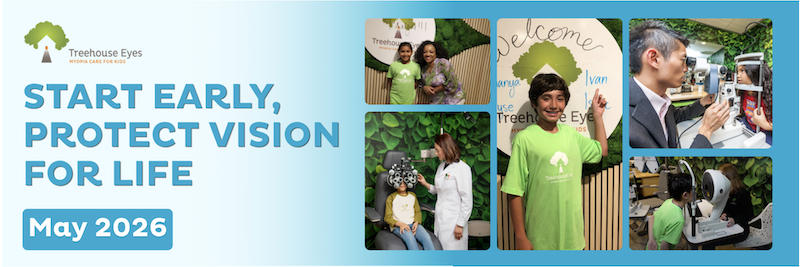
Myopia Awareness Week | May 18–24, 2026 | Start Early, Protect Vision for Life
Every year, millions of parents take their child to get an eye exam and leave with a new glasses prescription and a vague sense that everything is fine. The child can see the board at school again. Problem solved.
Except it isn’t.
If your child has myopia (nearsightedness), a new pair of glasses corrects their symptoms, but it does nothing to slow what’s actually happening inside their eye. And what’s happening matters far more than most families realize.
Myopia Awareness Week (May 18–24, 2026) exists to change that. This year’s theme, “Start Early, Protect Vision for Life,” is a call to action for parents, educators, and eye care professionals to stop treating myopia as a minor inconvenience and start treating it as the progressive eye disease it is.
At our practice, we see children with worsening myopia every week. Consider this your reset on everything you thought you knew about your child’s nearsightedness.
What Is Myopia, Really?
Most parents think of myopia (nearsightedness) as a simple inconvenience: a prescription to fill, a problem solved. But myopia is actually about the physical shape of the eye. In a myopic eye, the eyeball grows a little too long from front to back. That extra length is what causes distant objects to look blurry.
Here’s the part that often surprises families: the eye keeps growing. And the longer it gets, the more the delicate tissue at the back of the eye gets stretched and stressed. Over time, that stretching raises the risk of some very serious eye problems, including retinal detachment, glaucoma, cataracts, and a condition called myopic macular degeneration that can lead to permanent vision loss.
To put that in plain terms: a child with moderate to high myopia has a 50% higher risk of developing glaucoma later in life, according to a review published by the NIH. And for children whose myopia reaches high levels, the risk of retinal detachment can be more than 21 times greater than someone with healthy vision.
These aren’t rare worst-case scenarios. They are well-documented risks that grow alongside your child’s prescription. The stronger the glasses get each year, the more important it becomes to do something beyond just updating the lenses.
How Common Is Childhood Myopia? The Numbers Are Getting Worse.
You are not imagining it. More kids need glasses than ever before, and they are getting them younger.
A large-scale study published in the British Journal of Ophthalmology looked at data from over 5.4 million children and adolescents across six continents and found that roughly 1 in 3 children worldwide has myopia today, up from about 1 in 4 just thirty years ago. Researchers project that by 2050, 740 million children around the world will be nearsighted.
Here in the United States, 42% of Americans are now myopic, nearly double the rate from the 1970s when only about 1 in 4 people were nearsighted.
At our practice, we see this shift happening in real time. Children are coming in younger, their prescriptions are getting stronger faster, and families are often caught off guard because no one told them this was more than a glasses problem. The COVID-19 pandemic made things worse: more time inside, more screens, less time playing outdoors. We are still seeing the effects of that today.
Why Is Childhood Myopia Getting Worse?
Genes play a role. If one or both parents are nearsighted, their children are more likely to be too. But genes alone don’t explain why myopia rates have nearly doubled in one generation. The environment has changed, and that’s where we can actually make a difference.
Two things in particular are driving the rise:
1. Too much time doing close-up tasks. Reading, homework, phones, tablets. When kids spend a lot of time focusing on things close to their face, it appears to encourage the eye to keep elongating. This doesn’t mean screens are evil, but balance really does matter.
2. Not enough time outside. This surprises a lot of parents. Natural light actually plays a role in keeping the eye growing at a healthy rate. When children are exposed to bright outdoor light, it triggers a release of dopamine in the eye that helps slow that growth down. Research has found that each extra hour spent outdoors each week was linked to a 2% lower chance of developing myopia, and children who get more outdoor time consistently show slower progression.
Experts recommend at least two hours outside per day. Most kids today get nowhere close to that.
One researcher in Australia was so convinced by the data that he helped a local school add more outdoor time to the school day. The following year, that school had half the number of new myopia cases compared to nearby schools. That’s not a small difference. That’s a meaningful one.
Why Glasses Alone Are Not Enough for Children with Myopia
This is the part of the conversation most families have never had with an eye doctor, and it’s the most important thing in this entire post.
When your child gets new glasses, they can see clearly again. But the glasses are only fixing what your child sees. They are not doing anything about what is happening inside the eye. The eye is still growing. The prescription is still getting stronger. And as we covered above, the risks that come with a higher prescription are still building.
Think of it like this: if you had a leak in your roof, you wouldn’t just keep putting a bucket under it year after year. At some point you’d want someone to fix the actual leak.
Myopia management is that fix.
Myopia management is a category of treatments that have been clinically proven to actually slow down how fast a child’s myopia gets worse.
Not just correct it. Slow it down.
As a Treehouse Eyes partner practice serving [City, State] and surrounding areas, we offer several proven approaches:
- MiSight® 1 day contact lenses: These look and feel like regular daily contacts, but they’re specially designed to slow myopia progression. They are the first and only FDA-approved soft contact lens proven to work in children ages 8 to 12.
- Essilor Stellest® lenses: These look just like regular glasses, but they’re built with over 1,000 tiny invisible lenslets that change how light focuses in the peripheral part of the eye. That signal helps slow down eye growth. Clinical studies found that children who wore Stellest lenses for 12 hours a day slowed their myopia progression by an average of 67 to 71% compared to children in regular glasses. They’re a great fit for kids who aren’t ready for contacts, since there’s nothing to insert or clean. Just put them on in the morning like any other pair of glasses.
- Orthokeratology lenses (also called Ortho-K): These are rigid lenses your child wears only while sleeping. Overnight, they gently and temporarily reshape the front of the eye so that your child can see clearly all day without any glasses or contacts at all. They’re especially popular with kids who play sports.
- Low-dose atropine eye drops: A small drop placed in the eye each night, atropine has been shown in multiple studies to significantly slow eye growth. It’s a simple, well-researched option that works well for many children.
Every child is different, and the right treatment depends on your child’s age, prescription, lifestyle, and how quickly their myopia is progressing. That’s why we start with a thorough consultation.
The earlier we start, the better the results. Through the Treehouse Eyes Vision System®, 78% of children showed no myopia progression in their first year of treatment. That means fewer prescription changes, less long-term risk, and a much better outlook for their eye health as adults.
What Parents in Can Do Right Now
Myopia Awareness Week isn’t just for eye doctors. It’s for every parent whose child squints at the whiteboard, sits too close to the TV, or comes home with a stronger prescription year after year.
Here’s where to start:
Ask a different question at your child’s next eye exam. Instead of “Does my child need new glasses?” ask: “Is my child’s myopia progressing? Have you measured their axial length? Could they benefit from myopia management?” These questions signal that you want to get ahead of the problem, not just react to it.
Take the next step for your child’s vision. If your child has already been diagnosed with myopia, or if you or your partner are nearsighted (which raises the odds for your kids), don’t wait for the next prescription update. Give us a call and schedule an appointment. We’re happy to talk through what’s happening with your child’s eyes and what options may be available to them.
The Bottom Line on Childhood Myopia Management
Getting stronger glasses every year is not just a fact of life for nearsighted kids. It is a sign that something is progressing and that there may be more at stake for their long-term eye health than most families have been told.
The good news is that we are no longer limited to just watching it happen. We have real tools that work, and Myopia Awareness Week is the perfect moment to start that conversation.
If you have a child with myopia, or a child who is at risk, the best time to start asking bigger questions is now. Their eyes are still developing, and that window for early intervention is one of the most valuable things we have. We are here to help you make the most of it.